H.E. Nasssir Abdulaziz Al-Nasser’s Remarks
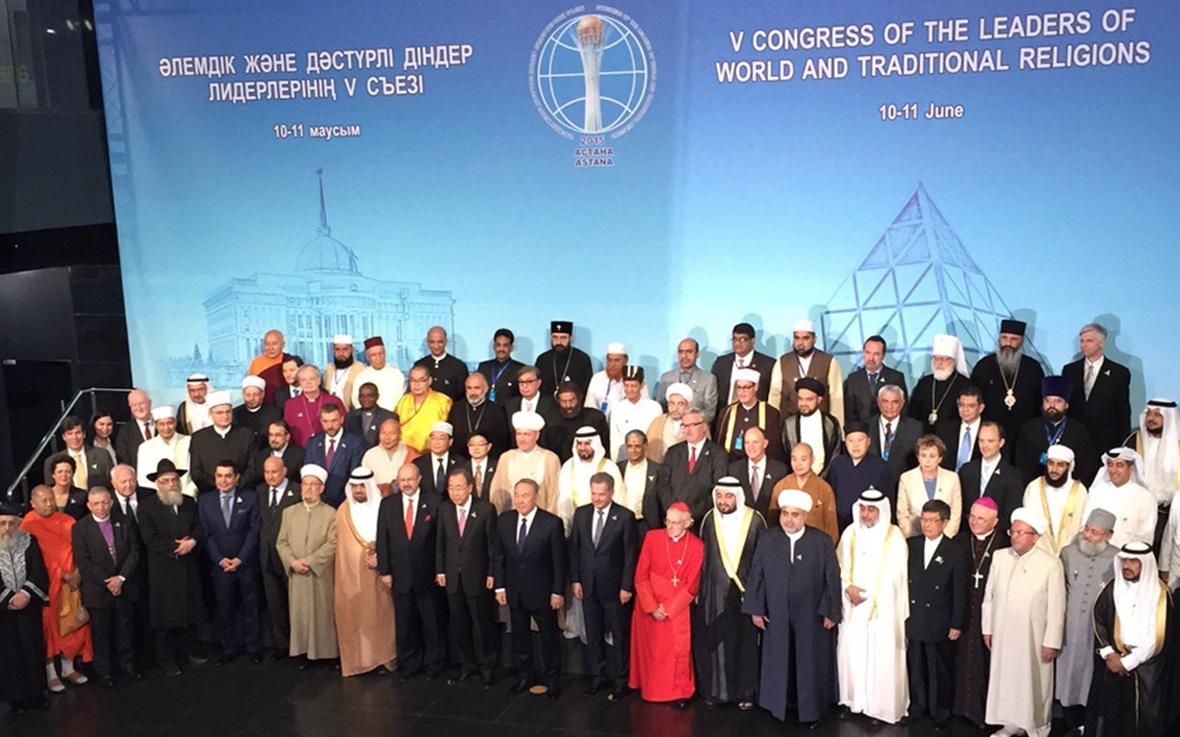
Congress of the leaders of world and traditional religions
Astana, 10 June 2015
Your Excellency Mr. Nursultan Nazarbayev, President of the Republic of Kazakhstan,
Your Excellency Mr. Kassym-Jomart Tokayev, Head of the Secretariat of the Congress of the Leaders of World and Traditional Religions,
Excellencies,
Distinguished faith leaders,
Ladies and Gentlemen,
It is a privilege for me to be here today. First, I would like to thank our hosts, the Government of the Republic of Kazakhstan.
In particular, I would like to thank His Excellency President Nursultan Nazarbayev for his visionary leadership on multiple fronts:
From launching this vital interfaith initiative from which the international community continues to benefit,
To the crucial role Kazakhstan is playing at the United Nations and other regional and sub-regional arrangements such as the OSCE, and finally, to the President’s highly courageous personal mediation efforts for which he is known internationally.
I remain convinced that the world has a lot to learn from Kazakhstan, especially with how ably this country manages its diverse communities consisting of more than 125 distinct ethnic groups, not to mention many different religions.
Ladies and Gentlemen:
Our world is in transition. Urbanization and undocumented migration are on the rise. With the Millennium Development Goals coming to an end, we are striving for an even more sustainable and equitable path to development.
Civil conflicts, coupled with terrorism, organized crime, illegal drug trafficking, and health crises threaten millions of people. More often than not, these dangers transcend borders.
In many countries seen as models of integration, we see divisive politics are on the rise, especially in areas where joblessness is high and the economic future uncertain.
The world is in dire need for a new and innovative role to be played by responsible religious leaders to their part in responding to the above mentioned challenges. They have the moral, ethical, and spiritual power to influence people.
With five of the seven billion people in this world identifying themselves as members of religious communities, the role of religious leaders in addressing these challenges is paramount. The UN especially needs the support of the women and men that lead our faith communities.
I see the role of religious leaders as having three parts:
- First, fostering dialogue to enhance a shared ability to face these challenges.
- Second, using their spiritual authority to compel individuals to act; and.
- Third, going beyond talking and taking real and measurable action to improve lives across communities.
Because I am convinced of the role religious leaders have to play, as High Representative of the Alliance of Civilizations, I started forming UNAOC Advisory Council that includes faith leaders, political leaders, thought leaders, and corporate sector figures to provide guidance for UNAOC in addressing these complex issues.
Around the world, we are seeing complex patterns of state breakdown and civil war. The MENA Region is a good example for pro-tracted conflicts that would so much benefit from honest mediation efforts by religious leaders who can conduct “cultural and religious mediation” as we call it at UNAOC.
No one can argue about the fact of existing cultural and religious root causes that should be taken into account once we embark on intervention through mediation for the peaceful settlement of disputes.
Clear examples for this fact is the Arab Israeli conflict, the internal conflicts in the Arab Spring countries and the cross border tensions in the Region of the Gulf that needs confidence building and genuine belief in shared responsibilities and interests.
No one can deny the cultural factor that fuels the violent conflicts in Ukraine, Myanmar, Central African Republic, Mali, Nigeria and elsewhere.
The results of these factors of instability are, among other security concerns: non-constitutional changes to authority, terrorism and the role of non-state actors (many of whom do not respect borders), networks of organized crime, social and religious violence, the miss-use of media and social media, and growing complexity that is overwhelming us and overwhelming the United Nations.
In the same context of my belief in the role of religious leaders, the Alliance also recently worked with the Office of Secretary-General Ban Ki-moon and the President of the General Assembly of the UN to convene a General Assembly Thematic Debate on “Promoting Tolerance and Reconciliation: Fostering Peaceful, Inclusive Societies and Countering Violent Extremism”.
During the debate, we were privileged to hear the views of religious leaders from several faith traditions around the world on this topic.
Today, we see violent extremism most vividly in the atrocities committed by Da’esh, Boko Haram, Al Shabaab, Al Qaeda and other sectarian and terrorist groups.
As the Secretary-General reminds us, addressing the profound challenge of violent extremism and terrorism in a manner that solves and heals — rather than multiplies — the problem may be the greatest test our human family faces in the 21st century.
At the end of the day, it is not religion that causes violence. It is individuals who choose to espouse violence, and sometimes, they wrongfully invoke their faith in doing so.
But who we choose as our leaders, including our faith leaders, really matters. This applies not only to age, but also to the crucial issue of gender.
We need greater female representation in our leadership. Women and young girls often bear the brunt of violent ideologies. They are subject to systematic abuse, killings, rapes, and kidnapping.
How can we provide a stronger, more equal platform to women, as a means of advancing respect for women and shifting global consciousness?
Not only this, but placing the world’s young people at the forefront of international peace and security is also a demographic and a democratic priority.
Sometimes my young son, Aziz, reminds me that we are the first generation that can end poverty in our lifetime, and also the last that can tackle climate change before it is too late.
We are living in a world where the global security landscape is shifting dramatically. I and we need to listen to what Aziz and his young friends are saying.
At the Alliance, we know from our experience of youth-led initiatives on the ground that peaceful and inclusive societies cannot be sustainably built without the participation, leadership, and engagement of young people.
Young people represent an extraordinary force of social progress. More than two-thirds of the world’s young people live in developing countries, with the largest proportion in Africa and the Middle East, two areas that have long suffered from violent extremism.
Over the last decade, the world’s attention on terrorism and violent extremism has resulted in a strong focus, in the media and popular literature, on youth as a major threat to global and national security and stability, especially male youth.
Sadly, recent dramatic events have demonstrated how young people can inevitably be brainwashed to commit heinous crimes and unspeakable violence, while also being victims of such acts.
The age profile of some countries’ populations has been cited as a reason to issue warnings that a “surging” population of young men inevitably drives increased violence and insecurity.
While surely dramatic images in the media can fuel the fears of policy makers across the world, it is critical to remember that age alone is not a risk factor as such.
Many countries with a high proportion of young people have not suffered violence.
The real danger comes when young people face limited educational and employment opportunities, and exclusion from social, cultural and political participation.
So, to close, I would like to offer suggestions in two specific areas that are relevant to the work of the Alliance: youth and media.
First, on youth, we MUST look beyond stereotypes and general assumptions, pursue evidence-based approaches on young people’s participation in conflict, and examine the underlying factors through human-centered approaches.
Strong communities that involve young people in decision making have the power to expand their sense of belonging. Such opportunities for empowerment act as important deterrents to engagement in violence.
I would like to draw your attention to one of our activities that religious leaders can participate in in the future. Within the UN, to recognize the positive role young people can play, several entities of the United Nations published last year the “Guiding Principles on Young People’s Participation in Peacebuilding”.
These principles represent a concerted effort by the United Nations and non-governmental organizations to promote youth as active stakeholders, participants, leaders and partners in peace processes, including in countering violent extremism.
Second, on media, journalists working in new and traditional media alike, play a vital role in our societies.
They contribute to building stronger, healthier and more peaceful societies when their reporting is balanced, objective, responsible and accurate.
Articles 19 and 20 of the International Covenant on Political and Civil Rights exhort us to honor free speech but also to prohibit advocacy of national, racial or religious hatred that constitutes incitement to discrimination, hostility or violence.
In other words, while free speech and expression are sacred, there is no merit in insult that constitutes incitement to hatred and violence.
I am a firm believer in the constructive role that media can play in increasing understanding of divisive issues across communities.
Not only this, but as an organization, it is imperative that we work on giving a platform to voices of credible individuals, such as religious leaders, who put out messages that counter hate speech and negative narratives. This is another area where partnership with religious leaders is key.
In closing, over the course of this Congress, I am looking forward to discussions that are concrete, practical, and honest from all of us. I am also excited about engaging with each one of you on the floor and on the margins.
My conviction remains strong that while some difficult challenges lie ahead, we can tackle them head on, with resolve and by working together with sincere intentions and focused actions.
I thank you.