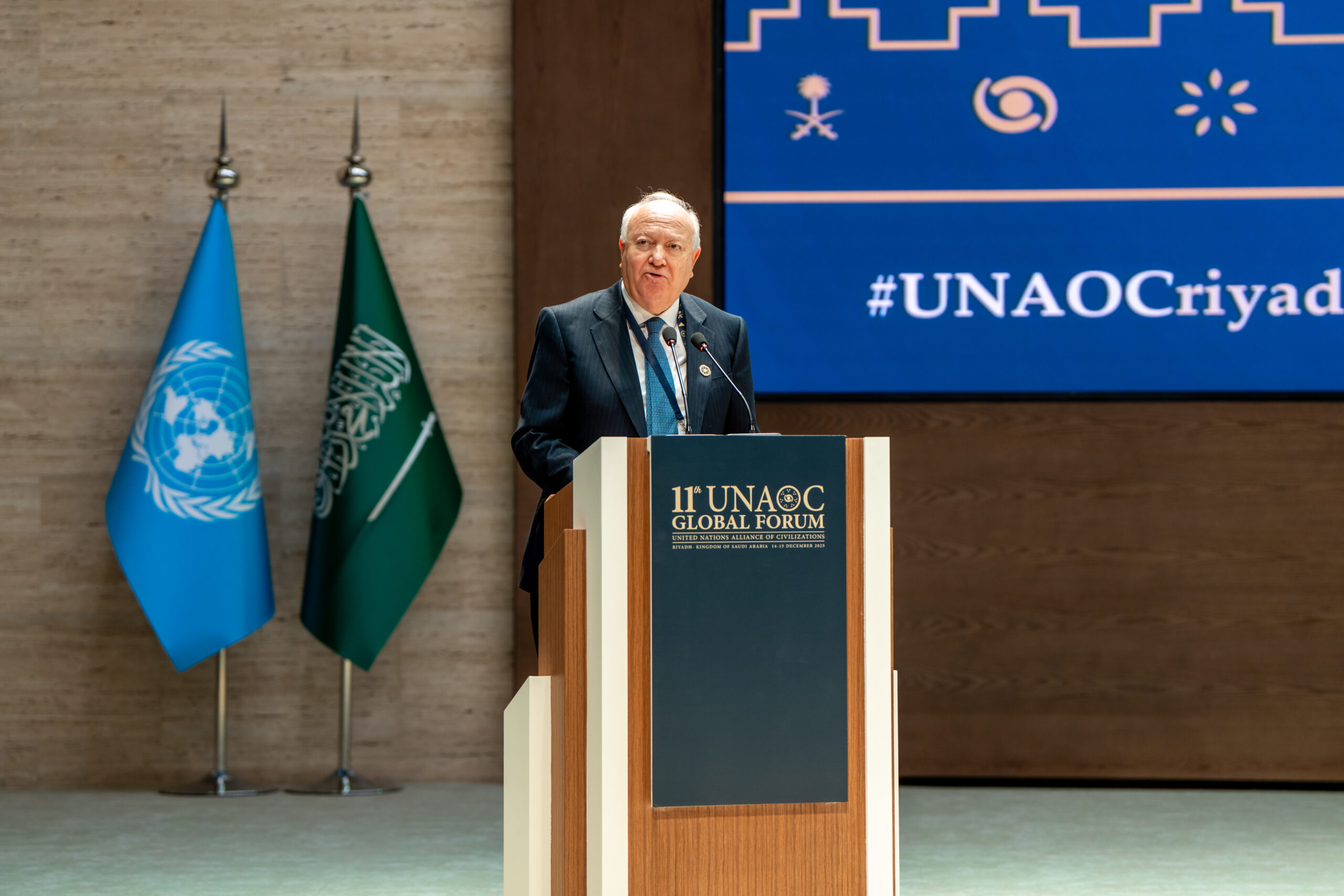
Remarks by Mr. Miguel Ángel Moratinos,
Under-Secretary-General, High Representative for UNAOC,
and UN Special Envoy to Combat Islamohobia
at the Official Opening Ceremony
of the 11th UNAOC Global Forum
14 December 2025, Riyadh, Saudi Arabia
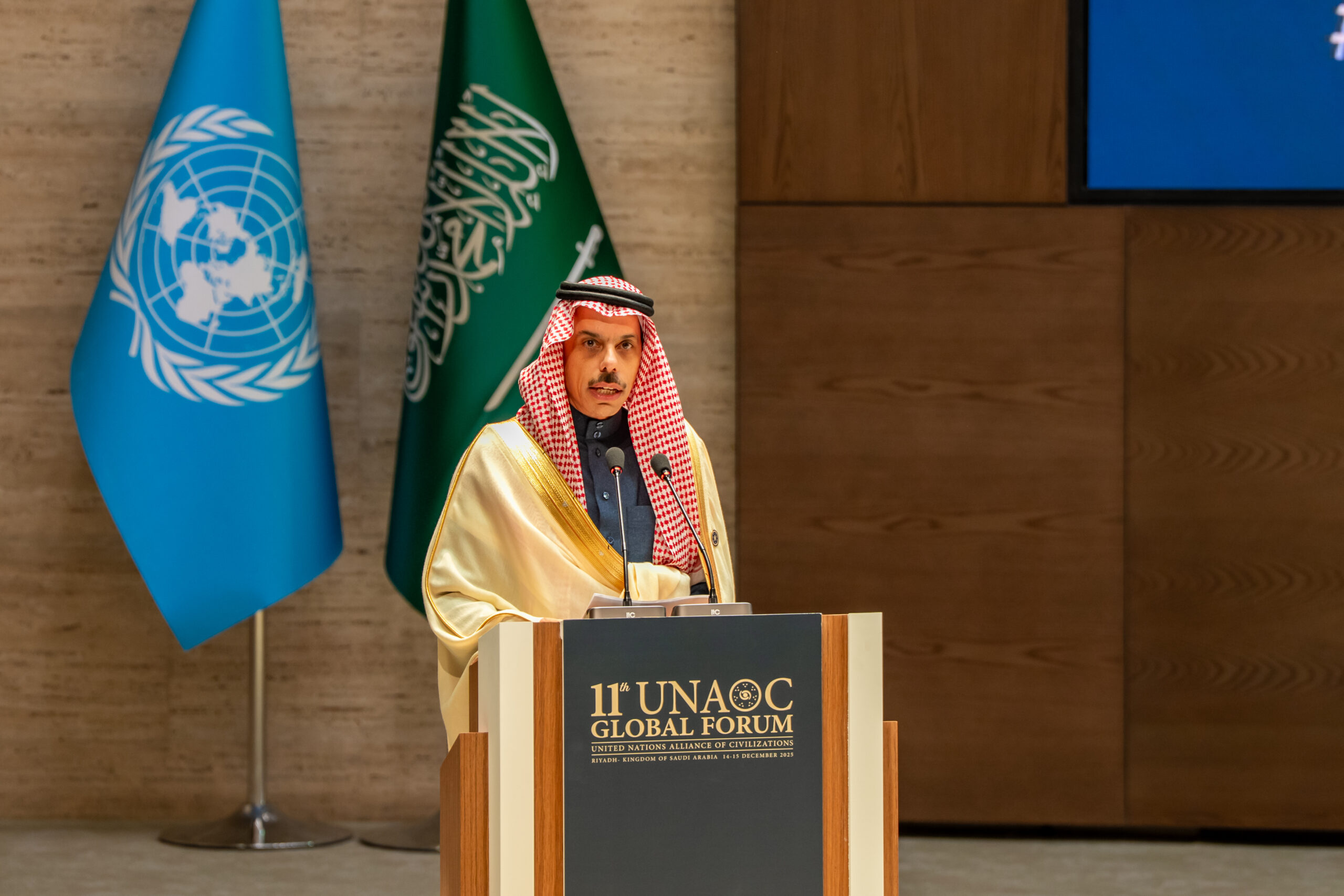
Your Highness Prince Faisal bin Farhan Al Saud,
Minister of Foreign Affairs of the Kingdom of Saudi Arabia;
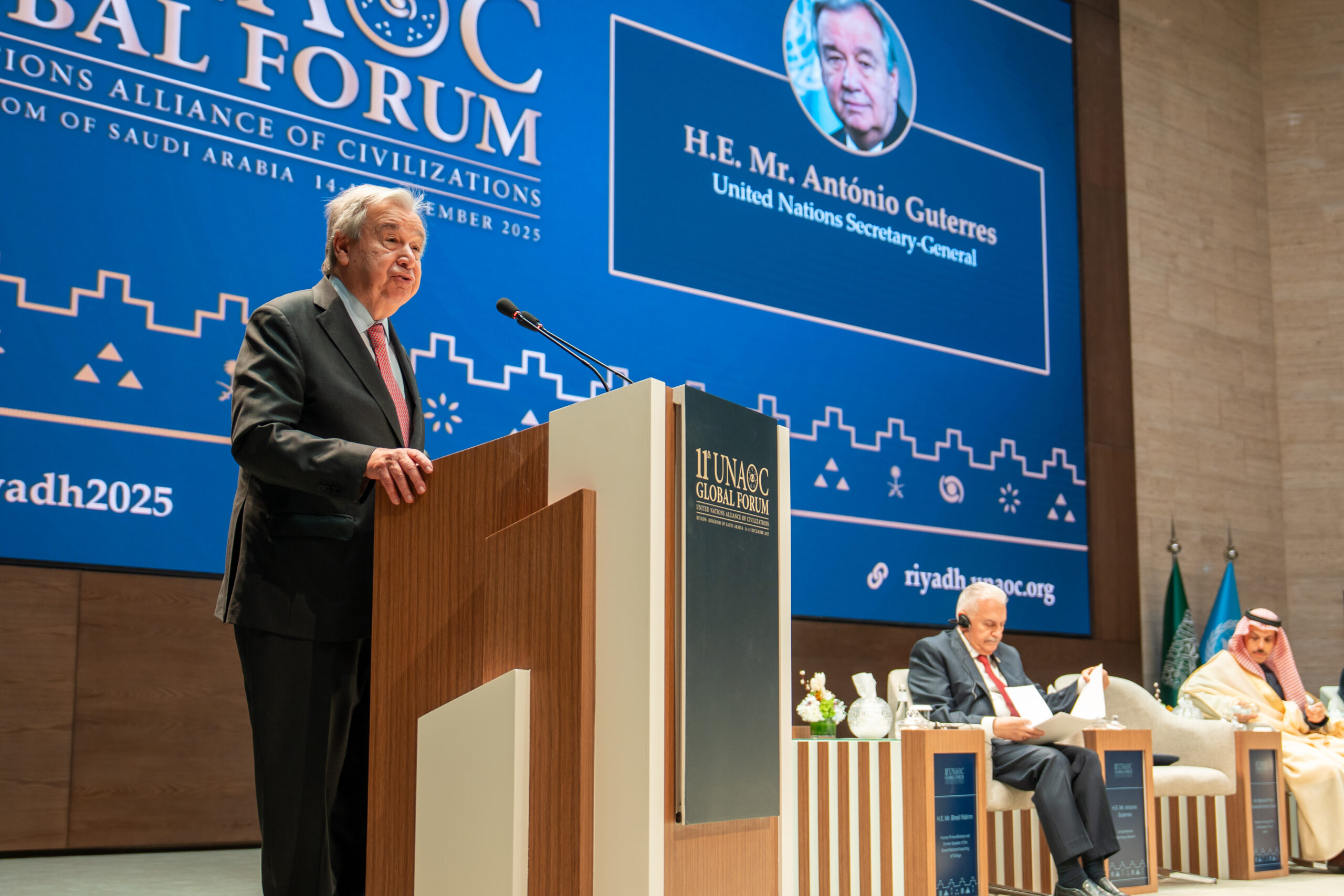
Secretary-General of the United Nations, Mr. Antonio Guterres;
Excellencies, Eminencies, Religious Leaders, Representatives of Civil Society, Youth, Distinguished guests;
Welcome to the 11th UNAOC Global Forum.
Twenty years ago, the Secretary-General of the United Nations, Kofi Annan, announced the establishment of a new initiative: the United Nations Alliance of Civilizations. The mission of this new entity was clear: to eradicate extremism and intolerance, address polarization and to build inclusive societies in which diverse cultures, religions, and civilizations could live in peace and harmony.
The Secretary-General envisioned a political and diplomatic instrument to prevent and resolve conflicts and crises while consolidating long-lasting peace.
As opposed to the so-called “Clash of Civilizations”, the United Nations believed in creating an “Alliance of Civilizations”, to put our collective efforts into combating extremism and terrorism through cooperation and dialogue.
Excellencies,
Over the course of the past 80 years, the World Order has shifted from bipolarity to unipolarity, and now to multipolarity. The optimism of the 1990s, when some proclaimed “the end of history,” faded after 9/11, which unleashed geopolitical turmoil and reshaped humanity’s trajectory.
There was a conviction that all global challenges could finally be addressed through the implementation of the Millennium Development Goals.
However, 9/11 changed everything: the terrorist attack against the World Trade Center in New York unleashed a geopolitical turmoil that changed the fate of humanity.
Two decades later, here in Riyadh, we acknowledge that multipolarity is a reality—but it is not yet reflected equally in the global governance architecture. All cultures and civilizations must have an equal voice in shaping this new world, contributing ideas rooted in their values to build inclusive and peaceful societies.
Your Highness,
Excellencies,
Distinguished guests,
The Alliance of Civilizations remains a vital platform for dialogue, respect, and mutual understanding. In 2025, as we marked the United Nations 80th anniversary, the Secretary-General launched reforms—The New Agenda for Peace, the Pact for the Future, and UN80—to adapt multilateralism to new realities.
We are in a moment of transition, and stakeholders are seeking their place in the future of the Organization.
This Global Forum is therefore crucial. Three key outcomes are expected:
First, UNAOC must strengthen its role as a platform for inclusive dialogue, particularly on identity, culture, religion, and civilizations. In a world dominated by social media and the rapid rise of Artificial Intelligence, we risk uniformity of thought and the erosion of creativity. If algorithms are not plural, democratic and rooted in our human values, we face a future devoid of innovation and human dignity. We will risk descending into paralyzing monotony and lose the ability to protect creativity and human dignity.
Second, UNAOC will prioritize preventive diplomacy and the fight against all forms of discrimination—whether based on race, ethnicity, sex, religion, or belief.
Excellencies, hatred is back. It has returned back with force, Large sectors of our communities are still rejected or excluded based on their faith, attire, or traditions.
How is it possible that, in the twenty-first century, we are still unable to live together in peace and with full respect for fellow citizens who profess a different faith?
Here, in the land of Islam, the Holy Qur’an reminds us in Surat Al Hjurat: : “O mankind, We have created you from a male and a female and made you into nations and tribes so that you may know one another. Verily, the most honorable of you with Allah is the most righteous of you.” The message is clear: diversity is a strength, not a threat.
Islam is a religion of peace. And yet, the Islamophobic obsession that exists today should have no place in any country that claims to be a defender of the Universal Declaration of Human Rights.
Likewise, antisemitism must be eradicated. Legitimate criticism of governments should not be perceived as antisemitic nor as a motive to demonize entire communities. My dual responsibilities —as the United Nations Special Envoy to Combat Islamophobia and UN Focal Point to monitor antisemitism and enhance a system-wide response —have never been more relevant. The same principle applies to protecting Christian minorities worldwide, including in the Middle East. All religions and civilizations should be respected and protected: the three Abrahamic traditions, as well as Hinduism, Taoism, Confucianism, Buddhism… All of them.
Excellencies, dear friends,
The time has come to reach a spiritual pact among all beliefs and religions—not only among the three Abrahamic traditions. This willingness to promote spiritual diplomacy was welcomed at the last Congress of Traditional and Religious Leaders in Astana in September 2025, and the same spirit is reflected in the People’s Republic of China’s initiative to advance the Dialogue among Civilizations.
Thirdly and finally, the core mandate of the Alliance must continue to be the promotion of peace. At the Fez Forum in 2022, we proposed launching an “Alliance for Peace”. We reiterated this idea in the Cascais Declaration, in 2024, and today I once again reaffirm it here in Riyadh, at a moment when peace is more necessary than ever.
On 26 April, in Gernika, Spain, UNAOC launched a new initiative: “A Call for Peace, the End of Wars, and Respect for International Law”, to defend peace at all costs. In October, we raised our voices for peace again in Sarajevo, Bosnia and Herzegovina. And in 2026, two capitals will be hosting this initiative: Beirut, Lebanon, and Luanda, Angola.
Last year in Cascais, His Majesty King Felipe VI of Spain described the Alliance of Civilizations as “the diplomacy of values.” President Zapatero has always stated that “peace is the task.”
Your Highness,
Eminencies and Excellencies,
Let us leave Riyadh with a renewed conviction: that dialogue is stronger than division, that respect is more powerful than hatred, and that peace is not a distant dream — it is a responsibility we share today.
The future of humanity will not be written by those who build walls, but by those who build bridges. Together, let us choose unity over fragmentation, hope over despair, and make this Alliance not only a forum for words, but a force for action. Let’s build an Alliance for Peace!
I thank you.